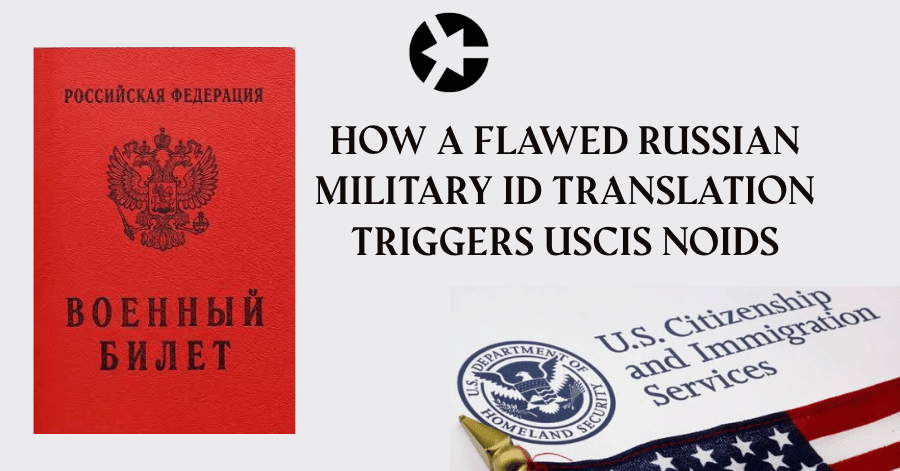
I recently reviewed a USCIS adjustment-of-status case in which the translation of a Russian military ID made the applicant look like a veteran. In fact, he had never served a day in the Russian army. He had been exempted from conscription for health reasons and enrolled in the reserve. His Moscow-based certified translator rendered the reserve entry as "transferred to the reserves," copied the fitness category as Latin "B," and on another page translated «ограниченно годен» as "fit for limited military service." USCIS read the translation as evidence of undisclosed military service and issued a Notice of Intent to Deny. The notice also pointed to his Form I-693, where the civil surgeon listed no medical conditions. A few word choices by a third party had turned an accurate I-485 answer into an apparent misrepresentation.
Key Points for Attorneys
- Two routine translation errors on a Russian military ID can make a client who never served look like a veteran who hid it.
- "Зачислен в запас" means enrolled in the reserve, not transferred. Russian law enrolls men in the reserve who were exempted from conscription and never served.
- Category "В" is the Cyrillic third letter: limited fitness for military service, a statutory ground for exemption from conscription. Rendered as Latin "B", it reads as the second, near-fit category.
- A corrected certified translation, backed by an expert opinion on the Russian statutes, usually resolves the discrepancy in an RFE or NOID response.
Why a military ID matters outside asylum cases
Russian men are required to keep a military ID (военный билет, transliterated as voennyi bilet or voenny bilet), so it surfaces in employment-based petitions (EB-1, EB-2), family-based cases and adjustment of status. Form I-485 asks every applicant whether they have ever served in, been a member of, or participated in any military unit. The interview officer then compares that answer with the submitted documents.
The comparison runs through the English translation, not the Russian original. Under 8 C.F.R. § 103.2(b)(3), every foreign-language document must come with a full English translation that the translator certifies as complete and accurate. If that certified translation says the applicant was "transferred to the reserves" and was "fit", while the I-485 says "no military service", the officer sees a conflict.
The officer may also check Form I-693. If the civil surgeon's report lists no medical conditions, USCIS may doubt that the applicant was ever exempted for health reasons. But the immigration medical exam is not a full medical history. Under the USCIS Policy Manual, Vol. 8, Part B, it addresses four health-related grounds: communicable diseases of public health significance, required vaccinations, physical or mental disorders with associated harmful behavior, and drug abuse or addiction. A condition that placed a man in category В before a Russian draft board years earlier may never appear in that report.
In most of these cases nobody misrepresented anything. The translator chose words that changed the legal meaning of the original.
Error 1: "transferred" instead of "enrolled in the reserve"
The Russian entry «зачислен в запас» is routinely translated as "transferred to the reserves." To an American officer, "transferred" implies a move from one status to another, usually from active duty to reserve duty. The translation therefore reads as proof of prior service.
Russian law does not support that reading. Article 52(1) of Federal Law No. 53-FZ "On Military Duty and Military Service" lists ten separate groups of citizens from whom the reserve is formed. Discharged servicemen are only one of them. Another group consists of men who did not serve because they were exempted from conscription. For them, enrollment is the first and only entry into the reserve. The accurate English is "enrolled in the reserve."
The same article creates a second trap. Under Article 52(3), a man enrolled in the reserve without having served, because of an exemption or a deferment, is assigned the rank of «рядовой» at the moment of enrollment. Translated as "Private," that rank looks to an officer like a rank earned in service. It is not; it is an administrative label attached to enrollment.
The entry that actually answers the officer's question is the legal basis of enrollment recorded in the ID. Where it cites an exemption from conscription, the document itself shows the person never served.
Error 2: Cyrillic "В" copied as Latin "B"
The fitness category on a Russian military ID is a letter, and the letter is Cyrillic. Paragraph 18 of the Regulation on Military Medical Examination, approved by Government Decree No. 565 of 4 July 2013, sets five categories:
- А — fit for military service
- Б — fit with minor restrictions
- В — of limited fitness for military service
- Г — temporarily unfit
- Д — unfit
The Cyrillic "В" looks exactly like the Latin "B" but is the third letter of the alphabet and the third category. A translator who simply copies it produces a "B" that an American reader places second in the sequence. The second Russian category is "Б", fit with minor restrictions. The copying error therefore moves the applicant one full category toward fitness.
The gloss makes it worse. Translators often render «ограниченно годен» as "fit for limited military service," which leads with the word "fit." The officer reads a positive fitness finding and asks when, where and in which unit the applicant served.
The Russian original says something different. Under Article 23(1)(а) of Law No. 53-FZ, citizens found of limited fitness for health reasons are exempt from conscription. They are then enrolled in the reserve under Article 52(1), as described above.
Category В is not a finding of total unfitness; that is category Д. It is a finding of limited fitness that the law treats as a ground for exemption.
A correct translation keeps the letter visible and explains it, for example: "Category В (V) — third of five categories: of limited fitness for military service; ground for exemption from conscription."
Side by side: what the translation says and what it should say
If you receive an RFE or NOID on the military ID
- Compare the translation against the original, page by page. Check every entry from the table above, including stamps and handwritten notes the translator may have skipped.
- Order a new certified translation that meets 8 C.F.R. § 103.2(b)(3) and keeps Cyrillic category letters visible with an explanation.
- Get an expert opinion on Russian law that ties each entry to the statute and explains what the document does and does not prove.
- Have the client explain the discrepancy in a short declaration: who made the first translation and that they relied on it in good faith.
- Present the issue as a translation error, not a credibility issue. The original Russian document is consistent with the I-485 answer; only the English version was not.
FAQ
Does a Russian military ID mean the person served in the army?
No. Russian men who were exempted from conscription and never served are also enrolled in the reserve and hold a military ID. The basis of enrollment recorded in the ID shows whether the person served.
What does fitness category "В" mean on a Russian military ID?
"В" is the Cyrillic third letter, not the Latin "B". It means "of limited fitness for military service", the third of five categories, and is a statutory ground for exemption from conscription.
Is "transferred to the reserve" a correct translation of «зачислен в запас»?
Not for a person who never served. The accurate translation is "enrolled in the reserve". "Transferred" implies a move from active duty that never happened.
Why does a military ID show the rank "Private" if the person never served?
Russian law assigns the rank of private to a man enrolled in the reserve without service, because of an exemption or a deferment. The rank comes with enrollment, not with service.
How an expert opinion closes the gap
An applicant's affidavit and counsel's argument tell the officer what the document means. An expert opinion shows it, entry by entry, against the Russian statute and the regulation that governs the record. That is what an adjudicator can rely on when the translation and the Form I-485 disagree.
I prepare expert legal opinions on Russian law and official Russian documents for USCIS and immigration court proceedings, including employment-based and family-based cases. The military ID is one example. The same translation problems arise with:
- name transliteration and patronymics across passports, birth and marriage certificates;
- the internal Russian passport and its registration stamps;
- police clearance certificates (справка о несудимости);
- civil registry (ZAGS) records, apostilles and their legal effect;
- Russian court judgments and their status under Russian procedure.
If an RFE or NOID turns on what a Russian document means, contact me at ab@strategiclitigation.center, +1 (470) 404-2105, or through strategiclitigation.center.
This article is general information, not legal advice on any specific case.
About the author
Dr. Anton Burkov is an expert on Russian law and official Russian documents and the founder of the Strategic Litigation Center in Boston. He prepares expert legal opinions for USCIS and U.S. immigration courts on Russian statutes, records and their translations in employment-based, family-based and other immigration cases.
Sources
- Federal Law No. 53-FZ of 28.03.1998, Article 52 "Enrollment in the reserve" (as amended 04.08.2026)
- Federal Law No. 53-FZ, Article 23 "Exemption from conscription"
- Government Decree No. 565 of 04.07.2013, Regulation on Military Medical Examination (as amended 24.03.2026), para. 18
- 8 C.F.R. § 103.2, Submission and adjudication of benefit requests
- USCIS Policy Manual, Vol. 8, Part B, Chapter 1: Health-Related Grounds of Inadmissibility