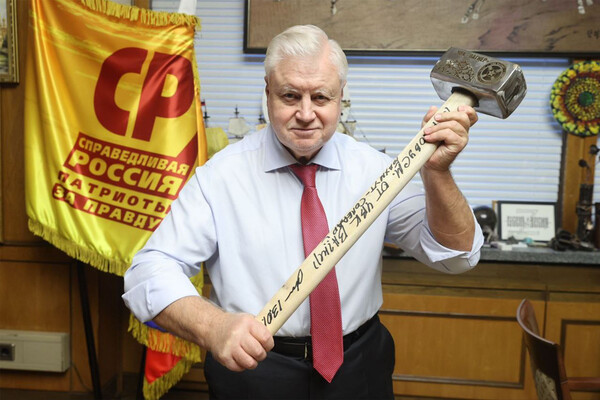
Photo: The leader of Fair Russia Mironov received a sledgehammer as a gift from Prigozhin.
In a recent merits hearing before a United States Immigration Judge, I testified as a country-conditions expert on the treatment of Russian men who refuse to fight in Ukraine. (Case details are omitted here; nothing in this account identifies the applicant or the proceeding.)
At one point the Judge stopped me. He wanted to be certain he had understood the method I had just described. To make sure, he illustrated it himself, on the record: he tilted his own head, mimed the blow, and asked me plainly whether he had understood correctly.
He had. And that moment — a judge leaning in, needing to be sure — is the reason this work matters.
What the Judge was trying to understand
In November 2022, a video circulated on Telegram channels associated with the Wagner Group. It showed Yevgeny Nuzhin, a prisoner recruited from a penal colony to fight in Ukraine, who had been captured by Ukrainian forces and, after publicly criticising the Russian government and stating he had intended to change sides, returned to Russia. The video depicts his killing with a sledgehammer, his head secured to a concrete block. The recording and its circulation were reported at the time by major international news organisations and have been examined in subsequent United Nations and non-governmental reporting on the Wagner Group.
What makes this a country condition, rather than a war atrocity in the abstract, is the documented official response to it.
Asked about the killing at a press briefing, the Presidential spokesman, Dmitry Peskov, replied that it was not the Kremlin's affair. Yevgeny Prigozhin, then head of the Wagner Group, issued a public statement endorsing the killing in terms widely reported at the time. Neither statement is disputed; both were made on the record and reported contemporaneously.
In January 2023, Sergei Mironov — a sitting member of the State Duma and leader of the "A Just Russia" party — published a photograph of himself holding a sledgehammer bearing the Wagner insignia, describing it as a gift from Prigozhin and thanking him for it. That photograph was published by Mr Mironov himself, on his own channels, and remains a matter of public record.
For the purposes of a Convention Against Torture claim, what matters is not how any of this is characterised, but what the record establishes and what the legal standard asks. The standard asks whether torture would be inflicted by, or with the consent or acquiescence of, a public official. Evidence relevant to that question includes whether the conduct was publicly known, whether officials responded to it, what they said when asked, and whether it was treated as criminal. Those questions are answerable from the sources above. The adjudicator draws the conclusion.
What makes this a country condition, rather than a war atrocity in the abstract, is the documented official response to it.
Asked about the killing at a press briefing, the Presidential spokesman, Dmitry Peskov, replied that it was not the Kremlin's affair. Yevgeny Prigozhin, then head of the Wagner Group, issued a public statement endorsing the killing in terms widely reported at the time. Neither statement is disputed; both were made on the record and reported contemporaneously.
In January 2023, Sergei Mironov — a sitting member of the State Duma and leader of the "A Just Russia" party — published a photograph of himself holding a sledgehammer bearing the Wagner insignia, describing it as a gift from Prigozhin and thanking him for it. That photograph was published by Mr Mironov himself, on his own channels, and remains a matter of public record.
For the purposes of a Convention Against Torture claim, what matters is not how any of this is characterised, but what the record establishes and what the legal standard asks. The standard asks whether torture would be inflicted by, or with the consent or acquiescence of, a public official. Evidence relevant to that question includes whether the conduct was publicly known, whether officials responded to it, what they said when asked, and whether it was treated as criminal. Those questions are answerable from the sources above. The adjudicator draws the conclusion.
Why it matters in an American courtroom
An Immigration Judge decides an asylum, withholding of removal, or CAT claim on the record in front of them — and on what they can genuinely understand from it.
Human rights reporting is indispensable, but a several-hundred-page compilation can bury the single documented fact that lets a judge see the risk a particular person faces. The Judge in that hearing did not need another statistic. He needed to grasp concretely what may await a man returned to a country where the killing of a person who refused to fight was filmed and circulated, and where the documented official reaction is what it is.
That is where a case can turn: not on the volume of the record, but on whether the factfinder understands the risk, can locate the state's role in it within the applicable standard, and can connect both to the applicant's own circumstances.
Human rights reporting is indispensable, but a several-hundred-page compilation can bury the single documented fact that lets a judge see the risk a particular person faces. The Judge in that hearing did not need another statistic. He needed to grasp concretely what may await a man returned to a country where the killing of a person who refused to fight was filmed and circulated, and where the documented official reaction is what it is.
That is where a case can turn: not on the volume of the record, but on whether the factfinder understands the risk, can locate the state's role in it within the applicable standard, and can connect both to the applicant's own circumstances.
The role of the expert witness
Turning a mass of sourced material into a concrete, credible, cross-examination-resistant picture is the work of a country-conditions expert. It is not advocacy. The sources do the talking, and the expert's job is to make sure they are the right sources, accurately stated.
In practice that means knowing which documented example answers the question the judge is actually asking; anchoring every assertion to authoritative material — U.S. Department of State reporting, United Nations findings, judgments of the European Court of Human Rights, court records, and credible independent journalism; keeping the applicant's own facts rigorously separate from general country conditions; connecting those conditions to a protected ground and to the individual's specific risk on return; and being able to stand behind every sentence under cross-examination.
A report that reaches beyond its sources is worse for the client than no report at all. Government counsel will find the gap, and the credibility the report was meant to supply goes with it.
Done properly, the expert does not tell the judge what to decide. The expert makes it possible for the judge to understand what is at stake — and, as in that hearing, to be sure of it.
In practice that means knowing which documented example answers the question the judge is actually asking; anchoring every assertion to authoritative material — U.S. Department of State reporting, United Nations findings, judgments of the European Court of Human Rights, court records, and credible independent journalism; keeping the applicant's own facts rigorously separate from general country conditions; connecting those conditions to a protected ground and to the individual's specific risk on return; and being able to stand behind every sentence under cross-examination.
A report that reaches beyond its sources is worse for the client than no report at all. Government counsel will find the gap, and the credibility the report was meant to supply goes with it.
Done properly, the expert does not tell the judge what to decide. The expert makes it possible for the judge to understand what is at stake — and, as in that hearing, to be sure of it.
If you are preparing a case
If you represent a client from Russia — or from any country whose conditions a court is unlikely to grasp from documents alone — retain a qualified country-conditions expert early, while there is still time to build the record before the hearing. Engaged in time, the right expert can turn abstract danger into evidence a judge can act on.
Dr Anton Burkov is the founder of the Strategic Litigation Center and a country-conditions expert witness on the Russian Federation in United States immigration proceedings — asylum, withholding of removal, and protection under the Convention Against Torture. He has litigated before the European Court of Human Rights for two decades and is a member of the International Advisory Board of the Human Rights Practice Program at the University of Arizona. He is based in Boston, Massachusetts.
Contact us at ab@strategiclitigation.center to discuss retaining an expert witness for your case.