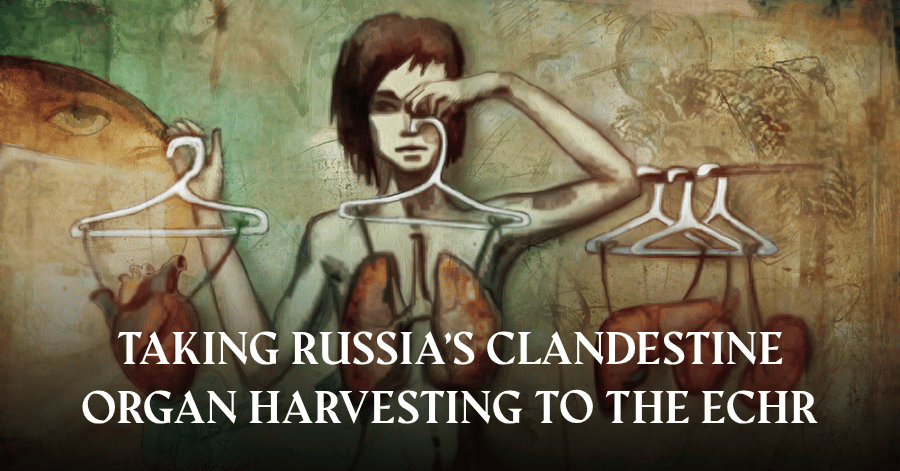
Alina Sablina, a 19-year-old female, was struck by a car while crossing a Moscow street. She was transported by ambulance and admitted to Intensive Care Unit No. 24 of the City Clinical Hospital No.1 with multiple severe traumatic injuries. Comatose, with a poor prognosis, she promised to be a perfect organ donor.
Alina didn’t die that day. She didn’t die the next day while her parents, Elena Sablina and Oleg Sablin, flew a thousand miles from their home in Yekaterinburg to be with her. Nor the next day as they sat at her bedside trying to adjust to this new image of their daughter, unconscious, caught in a medical spider’s web of tubes and wires, the persistent flashing, beeping lights of intensive care telling them only that their daughter was still alive. And, if she was alive, that she still had a chance.
She didn’t die the next day as the doctors told her parents that the chances for Alina’s survival were poor, but that they would do all that they could for her. She didn’t die the next day, nor the next. She didn’t die on any of the days that her parents sat at her bedside living the slow ticking horror of helplessness and hope as their child lingered and her doctors struggled to keep death from stealing her away from them.
The Secret Preparation for Organ Harvesting
What Elena and Oleg were never told, was that from the first day of her hospitalization, Alina had been designated as a promising source of transplant organs for harvesting. The same doctors who were reassuring Oleg and Elena of their best efforts in Alina’s fight for survival, were at the very same time secretly preparing her to have her organs removed after she died.
After six days, Oleg and Elena arrived to visit their daughter and were simply told they could not see her. A second attempt to see Alina on the same day was rebuffed by the ward doctor with anger, evasiveness and an insistence that they leave the hospital.
Sometime on January 18, 2014, Alina’s parents received a telephone call from an agent at a Moscow funeral home who wanted to retrieve their daughter’s body from the hospital morgue. That is how they were informed that Alina had died. Suddenly, invisibly, after seven days, of hope and fear, of tearful prayers and desperate promises to God, their daughter was gone.
The Post-Mortem Medical Violation
The official record shows that Alina Olegnova Sablina died at 11:20 PM on January 17, 2014. In the ensuing hours, her heart, both kidneys, her adrenal glands, portions of her aorta, her vena cava, and a segment of one lung were removed, though the surgeon’s notes state that only two organs were taken. What remained of her body was left in the hospital morgue, then shipped to Yekaterinburg to eventually be buried in the cemetery plot her parents had picked out for her.
Weeks later, while looking through records related to the criminal case brought against the driver of the car that had struck her, Alina’s parents discovered that their daughter’s organs had been taken. For Elena and Oleg, the betrayal and violation of Alina’s body was devastating. The child who had been torn from them in life, had seemingly then been torn apart in death. Without explanation, acknowledgment or apology, as her mother would later describe it, Alina, “was gutted like a pig.”
Alina’s parents have never received any official notice of their daughter’s death from the hospital. No doctor has ever explained to them how their daughter came to die, nor any acknowledgement that those entrusted with her care had secretly planned out and clandestinely executed the harvesting her organs. The four harvested organs missing from the medical record have never been accounted for. Without evidence as to where they ended up, or why, one can say only that they simply disappeared. No one has ever apologized to Elena or Oleg for the medical violation of their child’s body.
The Legal Framework of Presumed Consent in Russia
Russian doctors take organs from dead patients in secret. Since 1992, Russian law has allowed for the harvesting of organs from deceased patients without their prior consent or the notification or permission of close family members.
The ease of securing organs along with a growing demand has encouraged the clandestine culture of secret organ harvesting to thrive in Russian hospitals. And because it is deliberately hidden, the number of organs that are harvested, and the final destination of those organs are simply not known. It is legally allowed, legally encouraged, and legally protected.
The Litigation Campaign at the European Court of Human Rights
Elena Sablina is fighting to change that.
Wanting no parent to ever again suffer the secret desecration of their child’s body, Elena has taken City Clinical Hospital No.1 in Moscow to court. Enlisting the aid of Russian human rights attorney Anton Burkov, of the Strategic Litigation Center, she has launched a legal campaign to change the abusive shadow culture of clandestine organ harvesting in Russia. The medical establishment and government officials have opposed her efforts. Her arguments and appeals have been rejected by the Russian courts.
Yet, Elena has persisted.
Her case is now before the European Court of Human Rights (ECHR), where her plea is a simple one: simple respect of basic human rights. The deep emotional bonds between a mother and child, between any family and its individual members, do not suddenly end at the moment of death. Governments and those to whom they grant the privilege of practicing medicine need to recognize and respect that fundamental truth of human life, and set the compass of their actions accordingly.
For the moment, Elena tries to go about her life while waiting patiently for the decision to be handed down from the European Court of Human Rights. Anton Burkov and the Strategic Litigation Center remain busy pursuing litigation on two more cases in Russia that are similar to Alina’s. There is hope that the decision of the European Court of Human Rights will be known sometime this year, and that it will change Russian law. Because, until Russian law changes, the secret assault on human rights through the unconsented and clandestine taking of organs from deceased patients in Russian hospitals will continue.
Dr Anton Burkov is the founder of the Strategic Litigation Center and a country conditions expert witness on the Russian Federation in United States immigration and asylum proceedings. He has litigated before the European Court of Human Rights for two decades and represents the applicants in Popov v. Russia, OOO Plastik Payp v. Russia, Tiunov v. Russia, Korolevy v. Russia, Sivoldayev v. Russia, Valyushchenko v. Russia, Sablina and Others v. Russia and Mardar v. Russia. He is a member of the International Advisory Board of the Human Rights Practice Program at the University of Arizona, and is based in Boston, Massachusetts.
Enquiries: ab@strategiclitigation.center | +1 (470) 404-2105