By Dr. Anton Burkov · Published 29 September 2026 · Updated 30 September 2026
Russian version of this article to share with your client is here: Доклад ООН об уехавших из России: что он значит для дела об убежище в США.
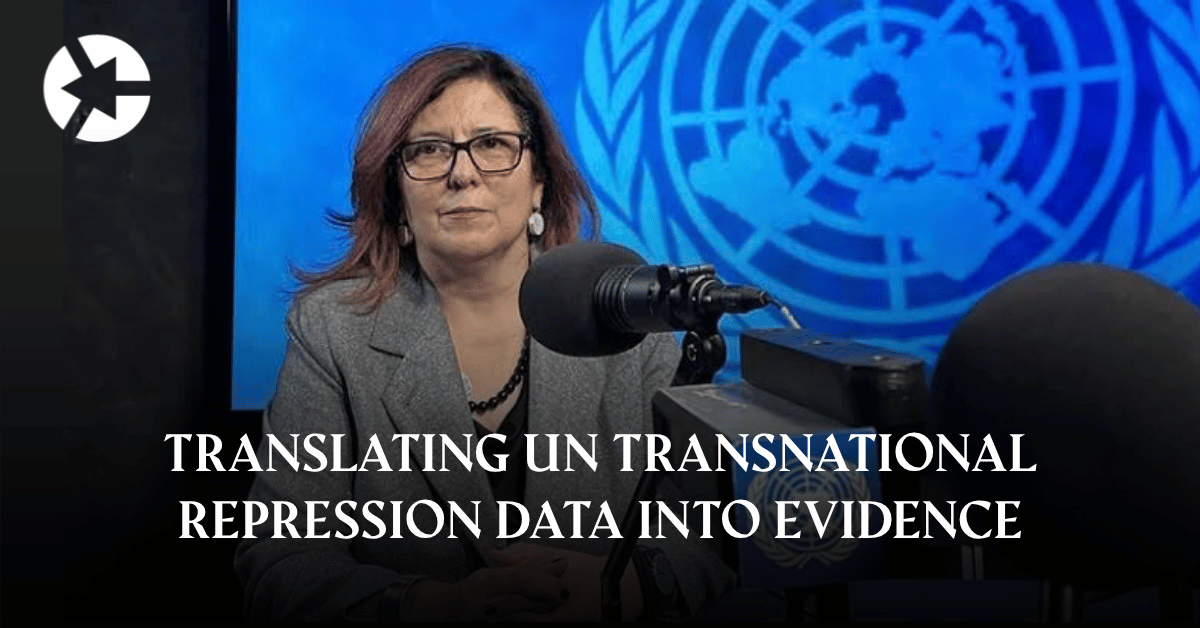
At the 63rd session of the UN Human Rights Council (7 September–9 October 2026), Mariana Katzarova, the Special Rapporteur on the situation of human rights in the Russian Federation, submitted her report A/HRC/63/60, "Nowhere is safe: exporting the rule of fear beyond borders – transnational repression by the Russian Federation."
The report illustrates the patterns it describes with examples from a database of close to 400 documented cases, which the Special Rapporteur notes is not exhaustive (para. 29). She concludes that the measures she describes form a systematic and institutionalized policy, directed at critics abroad and at their relatives who remain in Russia (paras. 20, 76).
For anyone who prepares country conditions evidence on Russia, this is a citable UN source. Three facts about its status matter:
- It is not binding. Special Rapporteurs are independent experts who serve in their personal capacity. Their views do not necessarily represent those of the UN.
- The Russian authorities did not respond to the Special Rapporteur's requests for information or to her requests to visit the country (para. 9).
- The current text is an advance edited version dated 8 September 2026. Paragraph numbers may change in the final version.
A source like this is only as strong as the precision with which it is used. Below is what the report actually documents, with paragraph references, and what it does not establish.
What does the UN report say about Russia? Key figures
- Emigration. Researchers cited in the report estimate that between 650,000 and 900,000 people left Russia after 2022 (para. 2).
- In absentia sentences. Documented in absentia sentences rose from 4 in 2022 to 157 in 2025, according to data submitted to the Special Rapporteur by a Russian human rights monitoring organisation (para. 25, fn. 18).
- Incidents abroad. Civil-society data sets record 29 incidents over the eight years 2014–2021, and 89 incidents over the three years 2022–2024. That is roughly an eightfold increase in the average annual number (para. 26).
- Rosfinmonitoring list. As of mid-2026, the list of "terrorists and extremists" included 21,541 individuals. At least 5,063 of them (23.5%) were prosecuted on administrative or criminal charges the report classifies as politically motivated. The share of such new listings rose from 9% before February 2022 to 41% in 2024 (para. 46).
- Compliance databases. According to the report, entries on this list are automatically disseminated through global compliance databases, including LSEG World-Check, LexisNexis and Dow Jones Risk & Compliance (para. 47). The report cites LSEG World-Check as stating that the information is passed to subscribers without individual verification (para. 47; see also para. 78). The report states that banks and other financial-service providers in the Americas and Europe have blocked accounts on that basis (para. 46).
- INTERPOL. Citing documents leaked to the media, the report states that Russia is the most prolific user of INTERPOL Red Notices, and that roughly half of the Russia-related cases reviewed by INTERPOL's oversight body in 2024 were found non-compliant with its Constitution (para. 39).
- Designations. By mid-2026, over 1,200 individuals and organizations had been designated "foreign agents," and over 380 organizations had been designated "undesirable" (para. 3).
Mechanisms the report describes
1. Measures affecting relatives in Russia (paras. 58–60). The report states that measures directed at relatives who remain in Russia have been increasingly documented since 2022; outside the Chechen context, they were rare before. The documented measures include "visits" and threats by security services, seizure of relatives' assets, the prospect of mobilization of male relatives, criminal prosecution of family members, and, in some cases, abduction and torture. The named examples concern relatives of Chechen exiles, of associates of a prominent opposition politician, and of an exiled Bashkir activist.
2. Surveillance and digital measures (paras. 41–42, 48–50). The report describes specific cases and methods:
- according to investigations cited in the report, tracking protest participants by cross-referencing intercepted mobile traffic with CCTV footage (para. 42);
- Monokle spyware, confirmed in 2024 by forensic researchers cited in the report, on a phone returned to its owner after detention (para. 42);
- a 2024 phishing campaign that researchers attributed to actors aligned with the Russian government (para. 49);
- a campaign against secure-messaging (Proton) accounts, exposed by civil society in early 2026; the report does not say who was behind it (para. 49);
- doxxing (para. 50).
The report does not state that the online activity of every member of the diaspora is monitored. Its examples concern specific people and specific methods.
3. Passports and consular services (para. 43). According to the report, an open criminal case, or an unpaid administrative fine of the kind imposed under the "foreign agent" legislation, can result in the withdrawal or non-renewal of a passport. The word is "can," not "will."
4. Federal Law No. 284-FZ of 4 August 2026 (paras. 15, 22, 44, 79). As described in the report, the law applies to Russian nationals abroad who have been convicted of any criminal offence, or held liable under specified administrative provisions, including those on "foreign agents," "undesirable organizations," statements about the armed forces, and calls for sanctions. Under the law, the Ministry of Justice is to maintain a public list of affected persons. Listed persons face 14 categories of restrictions. These include the freezing of funds and property; withdrawal of most consular services, including the issue and renewal of passports; refusal of all digital State services; and bans on notarial acts, powers of attorney, property transactions and remote banking. The Special Rapporteur describes the effect as "civic death" (para. 79).
5. In absentia proceedings and wanted lists (paras. 25, 33–40, 80, 85(k)). The report notes that in absentia trials are not unlawful per se, but states that they have increasingly been used against critics abroad (para. 25). It recommends that courts and prosecutorial authorities treat in absentia judgments and politically motivated criminal charges as high-risk indicators of transnational repression, and that asylum procedures identify transnational repression as grounds for protection (para. 85(k)). This is a recommendation addressed to States. It is not a statement of United States law.
What the report does not establish
- It does not assess individual risk. The figures are aggregate. They describe patterns, not any particular person.
- Some attributions are not confirmed. For example, the report mentions "Center 795," a structure whose existence was alleged in investigative reporting from March 2026, and the Special Rapporteur states that attribution of specific operations to it cannot be independently confirmed (para. 21). For two suspected poisonings in October 2022, attribution remains pending the outcome of investigation; for a third, in 2023, no cause has been publicly established (para. 31).
- Most named examples are well-known figures. The report states that the range of targets has widened since 2022 to include ordinary anti-war emigrants (para. 27). But many of the cases it names involve well-known journalists, activists and members of the Chechen diaspora. Applying them to a person with a low public profile requires explanation, not assumption.
The expert witness's task: from the UN report to the individual
In Matter of G-M-I-, 29 I&N Dec. 431 (BIA 2026) (PDF), the Board of Immigration Appeals addressed the weight of expert testimony in a Convention Against Torture case concerning China. Three points in the decision bear directly on how a country conditions report should be written:
- An expert's opinion is significantly undercut when it rests on anecdotal or inaccurate facts. In that case, the expert relied on two examples that did not match the person's circumstances, and one of them was described incorrectly.
- Generalized evidence that is otherwise insufficient to show an individualized probability of torture does not become sufficient merely because an expert reviews it and offers an opinion.
- An expert adds little when the testimony only interprets material that immigration judges already handle routinely, such as country reports and news articles.
For an expert, the lesson is practical. Every cited fact must be accurate and sourced. There must be a clear, documented link between the general picture and the individual. And the expert's report must add knowledge that the judge cannot take from the UN report alone. A UN report can support the general picture. It does not replace that link.
What an expert report can show
Where the facts support it, a country conditions report can show:
- Which specific mechanism applies to this person: a listing, a criminal or administrative case, a fine, measures affecting relatives, or a refusal of documents.
- Documents that confirm it, including dated captures of entries in public registers:
- the Rosfinmonitoring list of "terrorists and extremists";
- the Ministry of Justice registers of "foreign agents" and "undesirable organizations";
- the Ministry of Justice list under Federal Law No. 284-FZ, once published;
- the Ministry of Internal Affairs database of wanted persons;
- court records published on Russian court websites.
- How similarly situated people have been treated, using examples that actually match the person's profile.
When there is no register entry. A missing entry does not by itself show that there is no risk. Nor does it prove risk. Registers reflect different procedural stages:
- "Foreign agent" register. Designation is made by the Ministry of Justice. Fines under Article 19.34 of the Code of Administrative Offences typically follow it, and since October 2025 a single such penalty can open the way to criminal liability under Article 330.1 of the Criminal Code.
- Rosfinmonitoring list. Inclusion can follow a procedural decision naming the person a suspect or an accused under listed Criminal Code articles, before any verdict (Federal Law No. 115-FZ, art. 6(2.1)(4)–(5)).
- 284-FZ list. Listing requires a final conviction or a final ruling under listed administrative provisions, plus official confirmation that the person is evading the penalty and is abroad, and a decision of the Ministry of Justice (Federal Law No. 284-FZ, arts. 3–4).
The expert's task is to identify, from the available documents, what stage the person's situation has reached and what steps typically follow, and to state clearly which conclusions rest on documents and which rest on expert inference.
Representing a Russian national in immigration proceedings and need a country conditions expert report built on verifiable sources? Contact Dr. Anton Burkov at the Strategic Litigation Center or request a sample report.
Dr. Anton Burkov is a country conditions expert witness on the Russian Federation in United States immigration and asylum proceedings. He is a member of the International Advisory Board of the Human Rights Practice Program at the University of Arizona, and is based in Boston, Massachusetts.
Enquiries: ab@strategiclitigation.center | +1 (470) 404-2105