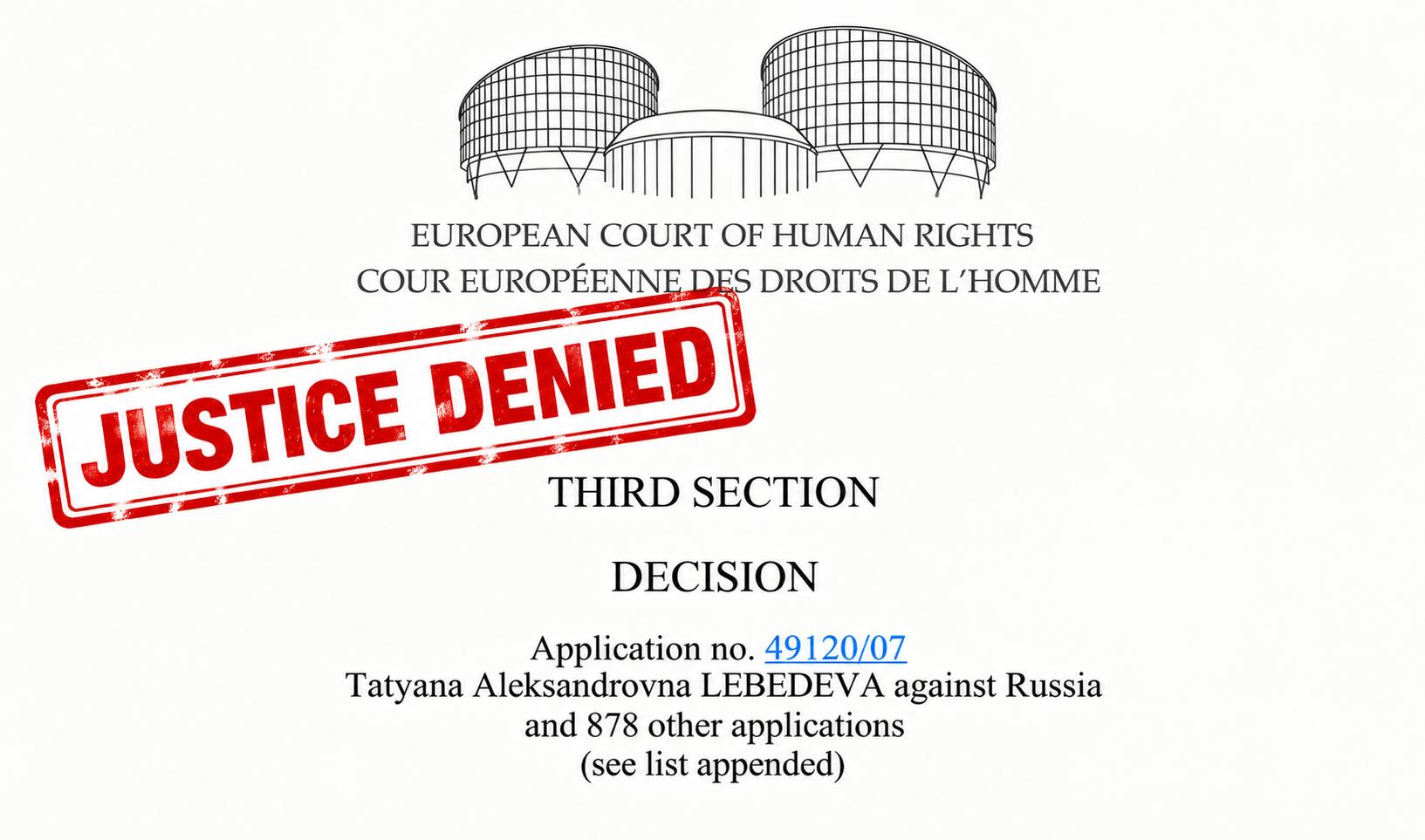
On September 3, 2026, the European Court of Human Rights (ECtHR) issued a sweeping decision in Lebedeva and Others v. Russia, striking out 879 separate applications against the Russian Federation in a single document. This procedural move impacted at least 1,534 applicants. While six of those applications saw prior findings on violations, the remaining 873 applications were closed with absolutely nothing decided on their merits. Among these dismissed matters were nine applications that I spent thirteen years litigating on behalf of the victims, including landmark cases like Sablina and Others v. Russia, Mardari v. Russia, and Valyushchenko v. Russia.
The Court explicitly confirmed that these complaints were not dismissed due to a lack of legal substance; in fact, the bench categorized them as “potentially meritorious”. Instead, the Court relied on Article 37 § 1 (c) of the Convention, citing administrative strain, Russia’s refusal to participate since March 2022, and the claim that these leftover cases raised no new issues of "marked importance" for the development of Strasbourg case law.
The Omission of the Public Record
The operational issue with the Lebedeva decision lies in its attached table of 879 rows. The published document contains only application numbers, case names, and dates, with zero description of what these individuals endured. For example, Sezeminy v. Russia—a prominent organ-removal case brought under the exact same non-consensual transplantation statute as Sablina—is listed without any context. The decision names themes in the abstract (e.g., fair trial, conditions of detention, data protection) but never connects a specific theme to a specific case, effectively erasing the official judicial narrative of these systemic abuses.
Crucially, in seven of the nine applications I represented, both sides had already submitted complete written observations long before Russia ceased cooperation. These cases were finished, fully argued, and required nothing from the respondent State. They did not need more time; they needed a judgment.
The Evidentiary Void in U.S. Asylum and CAT Proceedings
By 2026, no applicant under this list expected financial compensation from the Russian Federation. What they desperately required was an authoritative document: a binding finding by an independent international tribunal corroborating that a specific state-sponsored human rights violation had occurred.
This document carries immense weight outside Strasbourg, specifically within the United States Executive Office for Immigration Review (EOIR) courts. For applicants who have fled Russia and are currently navigating asylum (Form I-589), Withholding of Removal, or protection under the Convention Against Torture (CAT), an ECtHR judgment provides independent, adversarial corroboration of persecution that almost nothing else can replicate.
By denying these applicants a final declaration, the Court did not just clear an administrative backlog; it denied them vital evidence necessary to satisfy their burden of proof in foreign immigration proceedings.
Operational Takeaway for Immigration Counsel
The structural closing of the Strasbourg avenue alters how a robust country-conditions record must be assembled. Because hundreds of meritorious claims will no longer culminate in an international judgment, immigration attorneys cannot rely on the ECtHR to validate systemic patterns of abuse.
The practical consequence for anyone building a Russia asylum record is clear: where it would have once carried a verified Strasbourg judgment, it must now carry customized, statute-based country conditions documentation built some other way. Documenting these unredacted statutory frameworks through individualized expert reports is now the primary mechanism to bridge this evidentiary gap and affirmatively rebut adverse credibility assumptions in U.S. courts.
Dr Anton Burkov is a country conditions expert witness on the Russian Federation in United States immigration and asylum proceedings. He is a member of the International Advisory Board of the Human Rights Practice Program at the University of Arizona, and is based in Boston, Massachusetts.
Enquiries: ab@strategiclitigation.center | +1 (470) 404-2105