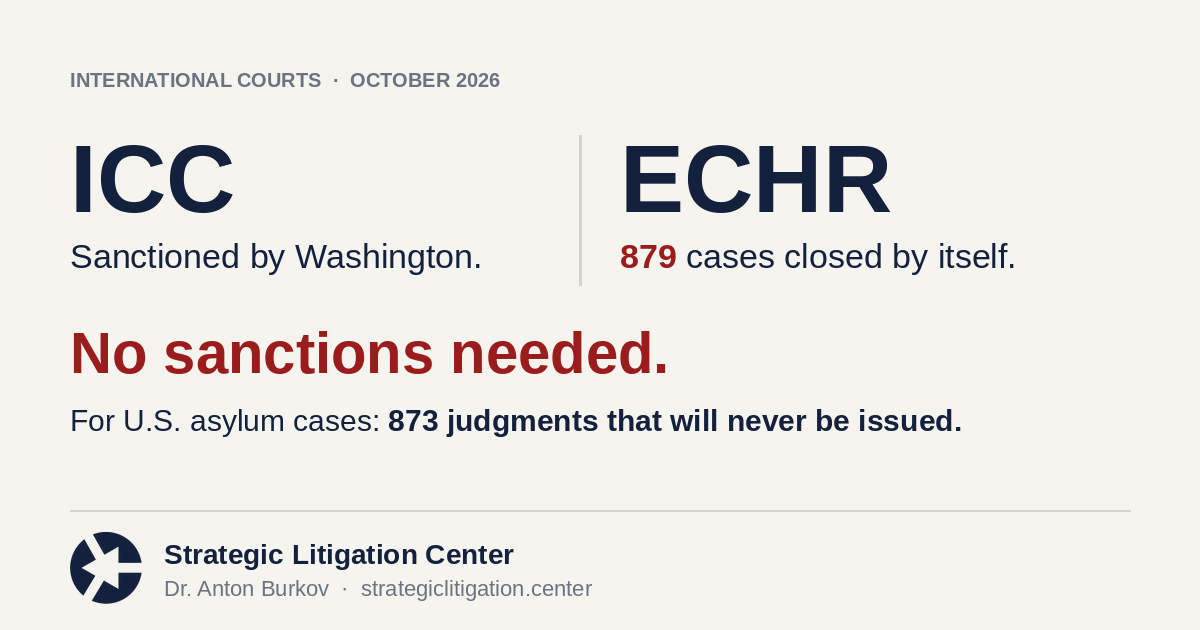
Sanctions against the ICC
On Oct. 9 the United States sanctioned the International Criminal Court itself. “Either the ICC will end its threats,” Secretary of State Marco Rubio said, “or we will end the ICC.”
Europe will rush to defend the ICC again, as it did two weeks ago, when the Dutch prime minister, Rob Jetten, said “hands off” the ICC “and all those other institutions that protect the international legal order.”
The ECHR needed no sanctions.
The ECHR closed 879 cases by itself
On Sept. 3 the European Court of Human Rights closed 879 individual applications in a single decision, without deciding any of them. More than 1,500 applicants. More than eleven thousand years of combined waiting. The court found the complaints “potentially meritorious” and closed them anyway.
With that, it gave up its function as a court of individual petition. No one had to sanction it to limit its jurisdiction. The court cut off its own hand.
No European government objected.
Removed from eComms
On Oct. 8 the court closed the last door. For each of my nine cases I received the same message: “The following application has been removed from your eComms account.” The cases are gone from the electronic portal through which representatives corresponded with the court for years. As far as I know, other representatives received the same messages.
What this means for asylum cases
For many applicants this is not abstract. A judgment of the European Court of Human Rights is one of the few documents in which an independent international court, having heard both sides, records what happened to a person. For those who left Russia and are seeking asylum in the United States, such a judgment could have been evidence.
Instead of 873 judgments, there is a table of names.
These cases mattered beyond the applicants themselves. A judgment that establishes how Russian authorities acted in a specific situation is country conditions evidence for others in a similar position.
My full analysis of the Sept. 3 decision was published by Harvard Law School’s Human Rights Program: Justice Refused — https://hrp.law.harvard.edu/justice-refused/