The applications contain records that remain accessible to US practitioners for litigation before the EOIR and USCIS.
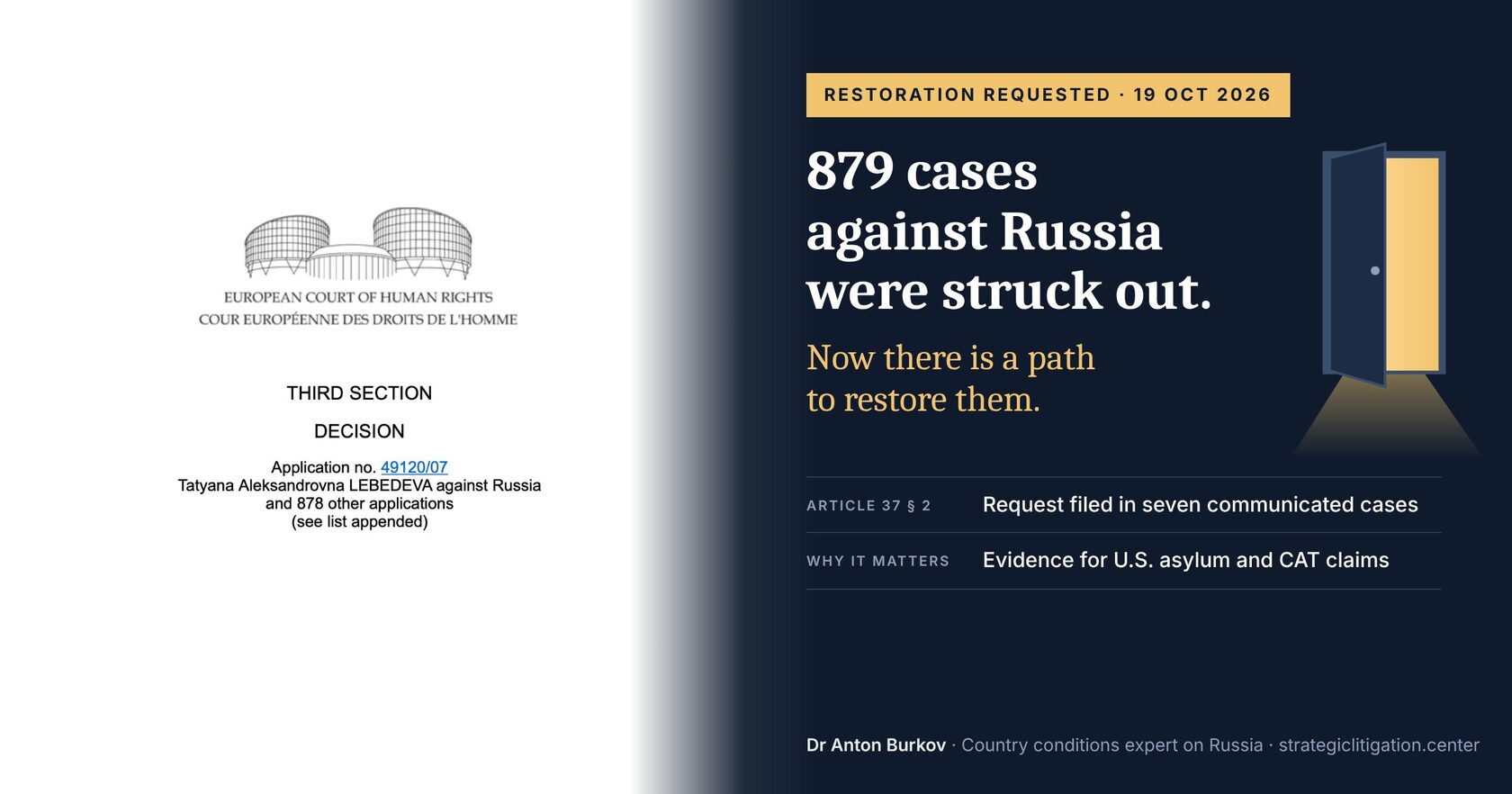
Following the cessation of the Russian Federation's membership in the Convention jurisdiction, the ECHR issued a collective decision in Lebedeva and Others v. Russia (Application No. 49120/07 and 878 other applications), striking a block of individual complaints from its docket.
In the formal request submitted to Strasbourg, I outlined distinct legal and procedural grounds proving that these seven applications meet the ECHR’s threshold for case restoration under Article 37 § 2. First, the motion emphasizes that adversarial proceedings are fully concluded; both the Russian Government and the applicants completed their written exchanges before Russia's non-cooperation phase, meaning the Court requires no further state participation to issue a final decision. Second, the absence of state cooperation creates no objective obstacle, as the ECHR already possesses comprehensive factual and legal arguments from both sides on file. The ECHR failed to offer the applicants an opportunity to comment before the strike-out—violating established Court practice in comparable cases like Sobol and Others v. Russia.
Decision “Lebedeva and Others v. Russia”
My motion for restoration targets seven cases that I litigated where the written adversarial exchange between the applicants and the respondent Government was fully concluded prior to the strike-out order:
- Sablina and Others v. Russia (Application No. 4460/16)
- Valyushchenko v. Russia (Application No. 51283/14)
- Korolevy v. Russia (Application No. 47668/15)
- Sivoldayev v. Russia (Application No. 39954/15)
- Tiunov v. Russia (Application No. 29442/18)
- Popov v. Russia (Application No. 23908/20)
- OOO Plastik Payp v. Russia (Application No. 8947/19)
Legal Grounds for Case Restoration Under Article 37 § 2
These seven cases satisfy the strict criteria established by the ECHR for resuming adjudication, providing US immigration attorneys with a clear roadmap of how international tribunals view the accountability of the Russian state:
- Concluded Adversarial Proceedings: Because the respondent Government filed its written observations and the applicants submitted their replies before the state's non-cooperation phase, the evidentiary record is complete. No further state participation or procedural steps are required for the Court to issue a ruling.
- Absence of Cooperation Obstacles: The ECHR possesses the complete legal and factual arguments from both parties. The state's subsequent refusal to cooperate does not impede the Court’s ability to adjudicate based on the existing file.
- Declaratory Value of Judgments: Under ECHR precedent, a final постановление retains its declaratory legal value regarding international state responsibility, independent of whether the current regime executes the judgment.
Strategic Application in US Asylum and CAT Proceedings
For US immigration attorneys navigating Form I-589 applications or seeking relief under the Convention Against Torture (CAT), the filings and Statements of Facts associated with these seven ECHR cases serve as country conditions evidence.
The ongoing effort to secure a formal judgement on these matters highlights the utility of international human rights litigation data in overcoming heightened administrative standards of proof in US immigration jurisdictions.
- Verified Evidence of Systemic Arbitrariness: the underlying records of these applications contain documentation regarding the fabrication of criminal charges, unlawful surveillance, unauthorized travel restrictions, and physical integrity violations within the Russian Federation.
- Admissibility in Immigration Court: Because these facts were submitted to an international judicial body and countered by state prosecutors before Russia's exit, they carry significant weight as neutral, third-party corroboration. They are highly effective when integrated into expert witness disclosures to prove a pattern or practice of persecution.
- Precedential Value of the HUDOC Database: The Statements of Facts for these cases remain permanently indexed in the ECHR’s HUDOC database. US practitioners can leverage these existing public records to substantiate individual claims of targeted persecution, even if the specific asylum seeker was not a direct party to the Strasbourg litigation.
The ongoing effort to secure a formal judgement on these matters highlights the utility of international human rights litigation data in overcoming heightened administrative standards of proof in US immigration jurisdictions.